Tuesday, April 2, 2019

The Dreamers 2003


Unlike the rest of his filmography, for the initial credits of Stolen Kisses (Baisers volés, 1968) François Truffaut introduced a dedication and a visual reference that are directly related to the events that took place in Paris during the filming of his movie (Stolen Kisses). The dedication, written with his own hand, is offered to Henri Langlois, founder and director of the French Cinematheque, while the visual reference is to the gate of the same entity in the palace of Chaillot, where a note that is found that reads closed until future news.

Now back to the Dreamers, it is to that same gate Isabelle seems to be chained, one of the protagonists of The Dreamers . This film is directed by the Italian maestro Bernardo Bertolucci. Isabelle, her twin brother Theo and a young American man, Matthew, t hey met there, they are part of the huge group of moviegoers who in February 1968 crowded around the film library to protest the dismissal of Langlois, sparked by a power struggle in the city. Several people were involved like Pierre Moinot, president of the film library, André Holleaux, head of the National Center for Cinematography and the culture minister, André Malraux.

In 1968, Truffaut interrupted the filming of Stolen Kisses to actively participate in the protests, which reached a climax on February 14, when the police confronted the nearly three thousand demonstrators grouped around the palace of Chaillot. ----May 68 had been anticipated a few months for the film community, through pressures, letters of solidarity from directors and actors around the world, and the virulent denunciations of the publication Cahiers du Cinéma group in other media, managed to reinstate Langlois in his position at the end of April. The start of the union protests and strikes in May coincided with the opening of the Cannes Festival, which was forced to cancel in solidarity with the movement that took place in Paris.

In the Dreamers, Bertolucci wanted to capture that era in his film with a combination of elements: being young, being a movie buff, being in Paris and living in 1968. However the Dreamers  is not a historical film. The Langlois affair underlies only as a backdrop, as a reason for the relationship between Isabelle  (Eva Green, in her film debut), Theo (Louis Garrel, the son of the great French director Philippe Garrel) and Matthew (Michael Pitt ), which is the true theme of the film. The director does, without a doubt, a tribute to the era and the intoxication of cinema in which many young people lived. As if it were a hallucinogen, the images on the big screen excite them, make them fly, transport them. Isa states that she was really born in 1959 and that her first words were "New York Herald Tribune", the same as Jean Seberg vociferates on the Champs Elysees in Breathless (A bout de souffle, 1960) by Godard. We believe her, many women were born to life with that free and mysterious image of  Seberg, who proposed to them a new model of life.

Matthew (Michael Pitt) is a young American who lives in Paris as an exchange student, there he meets the university students Isabelle (Eva Green) and Theo (Louis Garrel), two brothers obsessed with film and very involved in the French May. Isabelle and Theo, whose parents are traveling, invite him to leave his hotel and live with them. There he discovers that they are Siamese twins and that they have a strange and unclassifiable relationship.

The three initiate a sexual relationship marked by the veiled attraction between the two boys and between the brothers among themselves. Matthew, who ends up getting involved in a protest demonstration with violent confrontations with the police, is the weak part of that trio and ends up realizing that the political ideals and psychological behavior of the brothers are incompatible with his relationship with Isabelle. Incest, probably the greatest taboo that exists in the West and polyamorous relations are present throughout the film. 15 years ago there was no talk of this type of love and Bertolucci, director of feelings and sexualities, dared to name it with a film as uncomfortable as it is beautiful.

A model for life. That was the cinema for them, that in their cinephilia they did not see another valid representation. They sought to transgress what was established by a reality dominated by their elders, they wanted to be like the actors and stars they admired, to recreate the scenes of their favorite movies, to discuss movies, to think about movies, to eat movies, to get drunk on celluloid. They were not people, they were characters in a film playing a role. Victims of the contagion of a disease transmitted by eye contact, all three have no remedy. Bertolucci takes pleasure in showing us that frenzy in which they wander, interspersing the protagonist trio with clips from the films they evoke, in a beautiful montage where we get a glimpse how deeply tattooed was film on their skin. They are weird people, freaks like Tod Browning's homonymous film that is cited in the film.

The three run through the Louvre trying to break the record set by the trio of Band of Outsiders (Bande à part 1964), fight over the pre-eminence between Chaplin and Keaton in the reign of the silent comedy or braid in impossible riddles involving Top Hat (1935), Queen Christina (1933), Blonde Venus (1932) and Scarface (1932). More than living, they imitate, they represent, they dream. Eric Rohmer said it, recalling his time as a film writer: "We did not live. Life was the screen, it was the movies, it was to discuss and write about them."

But every philia has its evil side and Bertolucci knows it. From its name, The dreamers is an escapist work and for that reason the characters decide to flee from the reality in which they live and give themselves to some private and perverse games to which the cinema has perhaps taken them, or at least- has convened. With the closed cinemateque, they seem to have lost the thread that has united them to the world and they are enclosed in themselves, inside the huge apartment that Isa and Theo's parents leave in their care. Bertolucci releases the ties and the ballast, and the balloon in which the trip begins to rise to infinity. As I have mentioned previously, the episode of the protests around the cinemateque was only an apology (but no less successful, even Bertolucci got the actors Jean Pierre Léaud and Jean Pierre Kalfon recreate their active roles they had in those days). The director wants to look closely at his characters, study them, learn how far they are able to reach in that perverse sexual game in which they descend in a dangerous spiral.

Many have criticized Bertolucci for having missed the opportunity to show us his version of what happened in that spring of 68, but the same happened with Truffaut: Stolen Kisses is not a politically compromised work. Antoine, his protagonist, is enamored and undecided and works as a hotel porter and then as a detective. No political statements, no awareness, no philosophical manifestos. The cinema reflects the world of its director, not necessarily the real world. Bertolucci does not want to chronicle Langlois, he wants to show a film about three people who lived there and who shared a special and complex connection.

As in The Last Tango in Paris (1972), the isolation of the characters is the trigger that leads them to explore themselves, in a perverse game that leads Isa and Theo to the limits of incest, initiating Matthew into a forced sexual awakening that at first it makes him drunk, but then rejects it, when things are taking a less clear course. However, unlike the film with Marlon Brando and Maria Schneider, the attitude of the director towards the behavior of the characters of the Dreamers is very compassionate, completely idealized, without judging or criticizing them. And that same attitude is that of his gaze: the camera of Fabio Cianchetti, with his sensual palette, embellishes the actions to a degree in which it is more about an aesthetic complacency than a faithful approach to the real, stripping the images of everything that indicate how low they are falling in their personal degradation. What actually happens only we see when the twins’ parents come back home and they find the three asleep, intertwined in the middle of the chaos they have converted  the apartment and that only now we seem to perceive, now that we have awakened from the hypnotic dream in which we were.

That is what Bertolucci led us to: imagine that everything was possible, that utopias were viable and that the revolution was crossing the street. That sex, politics and cinema were a precise combination. When in reality we were naked and didn’t know it: "Then both of their neyes were opened, and they knew they were naked so they put together fig leaves and made aprons," this is what the biblical text reminds us. The director awakens us from the youthful dream we had. Now we are adults, now the streets are full of demonstrators. We join them knowing that nothing will ever be the same again, that what we dreamed has ended. The movie came to an end. The projector went out, someone turned on the lights of the theater. It's time to leave: life awaits us.

Directed by Bernardo Bertolucci
Produced by Jeremy Thomas
Screenplay by Gilbert Adair
Based on  The Holy Innocents by Gilbert Adair
Cast:
Michael Pitt  Matthew
Eva Green as Isabelle
Louis Garrel as Théo
Anna Chancellor as Mother
Robin Renucci as Father
Jean-Pierre Kalfon as Himself
Jean-Pierre Leaud as Himself
Florian Cadiou as Patrick
Pierre Hancisse as First buff
Valentin Merlet as Second buff
Lola Peploe as The Usherette
Ingy Fillion as Théo's girlfriend


Friday, March 15, 2019

Blue Velvet 1986


The trilogy made up of “Eraserhead”, “Elephant Man” and “Dune” showed us the first David Lynch. The type of director who in his first steps had shown to be a profound connoisseur of classical cinema but also a skilled weaver of postmodern atmospheres, a director capable of being universal despite the profound authorship of his proposals. After concluding this trilogy, Lynch undertakes another great challenge, the strange and fascinating “Blue Velvet”, which Woody Allen himself, among others, said it was the best film of that year, 1986.

Due to the failure of “Dune” Lynch believed that Dino de Laurentis would not produce a film of his, but he was wrong, when reading the script of 'Blue Velvet' (a script that took many years to master), Laurentis was amazed and prepared to give him another chance, after that the difficult production of this masterpiece began.

Thirty three years ago, this fictional film, a little strident in its visual and plot proposal, appeared before the world of cinema. A film which according to important critics of the time, catapulted David Lynch, as one of the most promising filmmakers of his time. However, due to his films done previously, he showed the interest and the selective acuity when narrating things visually; it could be said that he carried through a totally postmodern way of narrating us his strange stories, full of uncertainty and with a fortuitous sensibility of a great lucid story.

This is the first time that Lynch was introduced into a nightmarish world, caused mainly by the brutal presence of characters outside the law, as well as the mentally unbalanced. According to his own words, the story came from the 1964 song 'Blue Velvet' by Bobby Vinton, and then a series of associations between a cut ear and a clandestine voyeur occurred. It took him a long time to put the pieces together, but what interested him most was to show the nauseating underground of a seemingly idyllic society (impossible not to remember the beautiful 'Twin Peaks', which traces something similar), in a disturbing journey by a man who can be curious.

What we normally see in a typical American film in terms of rigor of structure, we would hardly find it in the premise that David Lynch showed us; a story with a nuance totally unusual in the classic narrative of cinema, what would be considered in a formal term, "auteur cinema."

The first images of this film are unforgettable. After some very elegant titles of credit, on a blue velvet curtain, and with the music of Angelo Badalamenti (who works for the first time with Lynch, admirably, for a collaboration as mythical as the one Hitchcock and Bernard Herrmann had), we go into a fade with the blue sky (we will also end with the blue sky), and some images of the bucolic suburban place where the action will take place, a place where the firemen walk with a smile (more tranquility would is impossible), to conclude with a man who has a heart attack while watering his garden.

With the help of actors such as Kyle MacLachalan, Isabella Rossellini, Dennis Hopper and Laura Dern, they contributed with their great acting skills to the plot. Taking it to situations that place you in complete suspense full of uncertainty but well marked by music and editing, even within the crude analytical situation about the characters and the vicissitudes to which they are subjected.  Afterwards, Lynch's camera enters the soil of that garden, and observes thousands of insects and cockroaches. More expressiveness would be impossible.

In a truly masterly way he has united the two worlds: the apparent and luminous, and the hidden and tenebrous. And with that event, the man who suffers an attack, a casual event, begins the story, because it will be his son Jeffrey (the great Kyle MacLachlan, in his second Lynch film after 'Dune') the driving force of the action, the in between character in a Derridian sense, when least expected, the action that precedes it, a totally closed shot focuses on a hole in the ground finding a cut ear full of ants (with the inescapable reference to Luis Buñuel) that will be the beginning of a terrible mystery in which he will not be able to avoid being involved.

Jeffrey is a good boy, responsible and hardworking, who is attracted to the dark side of existence. He wants to taste that fear and that darkness, the sordid and he's going to get a good portion of it. This is a classic figure of "film noir", the innocent man who will be involved in a nightmare because of the morbidity that a woman, or a mystery, or both, produces. Soon he will also meet the daughter of the detective in charge of the case, the wonderful Laura Dern (really, the favorite actress of this director).

Sneaking into the apartment of the beautiful and mysterious singer Dorothy Vallens (a sensational Isabella Rossellini), Jeffrey will start an adventure in which a psycho gangster (formidable, unforgettable Dennis Hopper) will horrify you with all kinds of perversions, weird sex, wild violence and in short, the absolute evil that Jeffrey longed so much to experience and that now he will suffer this in his own flesh. He wants to learn things, even if that means taking risks. His reckless plan will almost cost him his life, but he will try to maintain his bruised innocence in the process.

From that experience that we speak of is intertwined with the character Frank Booth, a psychopath. For everything he does where his alteration is suffocated by an oxygen tank which he carries with him wherever he goes. That degree of upheaval can be seen in Jeffrey with his constant visits to Dorothy Vallens with whom he goes to in search of sex, and a desire to subdue her by physically and verbally assaulting her. Dorothy Vallens in the face of suffering of her kidnapped son lives in total dichotomy with the anguish and the desire to be beaten when she meets Jeffrey. By using this female that way in the movie, Lynch shows us the use of violence as a method of survival, feeling and purification. He will then meet the detective’s daughter who will be key in what Jeffrey is trying to investigate. We can say that this type of cinema goes beyond an artistic approach. For this film David Lynch received an Oscar nomination, however more than anything it was the criticism that catapulted his ideas and he was able to continue this type of work in later years.

Stylistic features
With the complete complicity of Frederick Elmes, with whom he had already worked with optimal results in “Eraserhead”, Lynch deploys a serene but steely staging, in which very sharp profile planes are common, and then turn them into frontal planes in which the horror, or beauty, of the situation, finally reveals itself. Photography is beautiful and brave, being able to combine the luminous with the gloomy, which is the theme of the film. There is also a desire to emulate a certain cinema from the past, in the form of photographing, for example, Laura Dern, as if she were a star of the twenties.

This is the first time that we have entered into one of those Lynchian atmospheres that have made him famous and that have been imitated so many times. Among all environments highlights, it is the Dorothy Vallens apartment, the beginning and end of the whole plot. It is an apartment, in which a disturbing red predominates, and with the characteristic Lynch furniture that makes us uncomfortable. That apartment is the door to another world, and its fundamental closet (place of hiding and perversion) remains engraved on our retina.

Lynch moves like a fish in the water in this convoluted and evil story, and is able to build tension and suspense with great skill. The film is not as wild as 'Wild Heart', nor as frantic as 'Lost Road', but just as tense and strange. Lynch opposes, with music and planning, the sweet and tender Sandy and the tragic and sensual Dorothy as two very different women who will give Jeffrey very different aspects of sensuality and love. This triangle is made of characters that Lynch understands and respects, and there lies an opportunity, unlike the assassin Frank, who has no chance of redemption.

This film is unquestionably one of Lynch’s masterpieces, who enters a stage of maturity and gets his first Oscar nomination for best director. He had to give up part of his salary, and he was forced to rewrite the story to cut costs, but he got what he wanted: total artistic freedom and access to final editing. This personal triumph consolidated him as an established author in the United States, and his fabulous criticism gave him the confidence to dive more energetically into that twisted universe that he continued to investigate in the coming years.

Directed by David Lynch
Produced by Fred Caruso
Written by David Lynch

Cast:     
Kyle MacLachlan
Isabella Rossellini
Dennis Hopper
Laura Dern
Hope Lange
George Dickerson
Dean Stockwell

Music by Angelo Badalamenti
Cinematography Frederick Elmes
Edited by Duwayne Dunham

Sunday, February 24, 2019

Manhattan 1979


A great romantic comedy. The script was co-written by Marshall Brickman and Woody Allen. Critics often say that it is a cinematic love letter to New York. Issac, a 40-year-old neurotic writer, is romantically involved with Tracy, a 17-year-old student. His love life is a complicated and slippery terrain: he is tormented by his second ex-wife Jill, a lesbian who has written a memoir where she tells all the intimate details of their marriage. He leaves his job to work on a memoir about living in New York. However, everything gets complicated when he starts dating Mary, his best friend's former lover. The reaction of the critics was very favorable and the film raised more than $ 485 thousand dollars in its first week. And, in all time, the amount reached $ 39.9 million. Adjusted for inflation, it grossed more than $ 127 million, making it the second largest movie at Allen's box office, after Annie Hall. The musical score is fantastic and homage to George Gershwin.

Allen would repeat with Manhattan, almost mimetically, the formula that gave him success a couple before, a work that goes back to addressing the meaning of relationships in New York in the 70s, from the perspective of the economic and intellectual high class. On this occasion, instead of showing an unfolded character, as he did in Annie Hall, he introduces his work by means of an omniscient narrator who not only narrates but also tells his own story, since he is a writer in the creative process of a novel. Thus, in the very opening of the film, this voiceover describes New York as a city in constant black and white, a rhetorical resource that justifies the romantic monochromatic treatment of the film itself. Since then, the film / novel could be understood as the soundtrack of a relationship, since Allen is responsible for alternating significant scenes of iconic moments in his private life with songs that evoke the actions we see on screen. Rhapsody in Blue is the theme selected for the opening and closing of the story. The chords composed by George Gershwin allow us to emphasize the emotional charge that Allen intends to infer in the presentation of the city, while the literal definition of rhapsody as musical work composed of fragments of other works, leads us to identify the director's tribute to cinema, music and literature. He loves and she loves could be cataloged as "the song" of Isaac and Tracy, his 17-year-old girlfriend, and will be played while they ride in a carriage, in love with Central Park. The title and the images reveal a love that, in some way, is intuited as a passenger, unstable by the use of the undefined present that does not allow knowing the recipient of such love, but the presence of a momentary passion. Later, when Isaac, after having abandoned Tracy, decides to return to find her repentant, the same song will sound again with a very different meaning, which comes to affect the resurgence -present- of a past love that was thought forgotten. . It is a pure and naive love of the innocent youth of Tracy.


I've got a crush on you will be the melody with which we identify the relationship between Isaac and Mary, the woman for whom he abandoned Tracy, who was the best friend’s lover, Yale. We see how the intricate web of sentimental relationships gets complicated, but Woody Allen succeeds in proposing an identifying sound support to make the assimilation process much simpler. The title, which would have another meaning like "being crazy about you", reinforces Mary's initiative to renounce her anti-artistic principles to accompany Isaac to the cinema. The song will also mention a love at first sight, arising not so much from the physical attraction as from the connection that you feel when you look at it, that will be just what happens with the protagonist when you see Mary for the first time, and decide to leave in an unreflective way to Tracy. Finally, we have selected the theme Do, do, do, from Gershwin, as well as the previous ones. This song is presented according to its composers as a furtive and playful kiss and would reinforce the idea of that second adolescence lived by Mary and Isaac. Two adults who are not expected to have such and ardent and childish behavior but the mature relationship they were not predestined to have. For this reason, the couple will not be able to have control and everything will be in a constant search for a Utopian and unattainable love for someone like Isaac, a passionate dreamer, and  above all and inveterate loner. 


Directed by Woody Allen
Produced by Charles H. Joffe
Written by Woody Allen and Marshall Brickman

Cast:
 Woody Allen
Diane Keaton
Michael Murphy
Mariel Hemingway
Meryl Streep
Anne Byrne
Music by George Gershwin played by the New York Philharmonic, Zubin Mehta and the Buffalo Philharmonic, Michael Tilson Thomas
Cinematography Gordon Willis


Sunday, February 17, 2019

Last Year at Marienbad 1961


"... This story is over. A few seconds and it will be frozen forever, in a marble past, like this garden carved in the stone, this hotel, with its rooms now deserted, these people motionless and silent, perhaps dead some time ago. Guardians of the corridors through which I advance to meet you, between lines of immobile, vigilant, indifferent faces. While you doubt, perhaps, staring at the entrance of this garden "


The voiceover (narrator) which walks us through the labyrinthine corridors and rooms of the hotel where the (non) history of The Last Year in Marienbad takes place gives us some clues about possible interpretations of this fascinating cinematic dream hatched by the two hands by the script by Alain Robbe-Grillet and Alain Resnais' camera (although the screenwriter claimed that the text he gave to Resnais "was more than a script", as it contained "the breakdown describing the film plane to plane, almost image by image, with the planned assembly ", always according to Robbe-Grillet, Resnais shot the film" respecting very carefully "the written" and “without ever intervening to try to modify something ", words with which the writer seems to claim greater authorship of the final work - an idea that, seeing the later works of the filmography of Resnais, one would not dare to question - although later,  this idea clarifies that Resnais nevertheless "turned the film into a work by Alain Resnais, into something much more psychological, through almost imperceptible changes, in the direction of actors, in the sound effects, in things so imperceptible that if you read my book and see the movie you may think they are exactly the same ").

Well, this fascinating creation that some have wanted to describe as an allegory about death or as a clear immersion in the world of dreams, as the pure representation of desire, as the disturbing universe of poetic creation or the immense and therefore unbounded space of ideas, gives even for multiple interpretations more, and, surely, to possible and reasonable arguments of which only you can be the creator. For a story as simple as its plot might seem, I warn you, it is only a plausible idea of what the plot could be and nothing more. The real story is directed to the emotions of the spectator through its representation, and to the disconcerting conjunction of images and words.

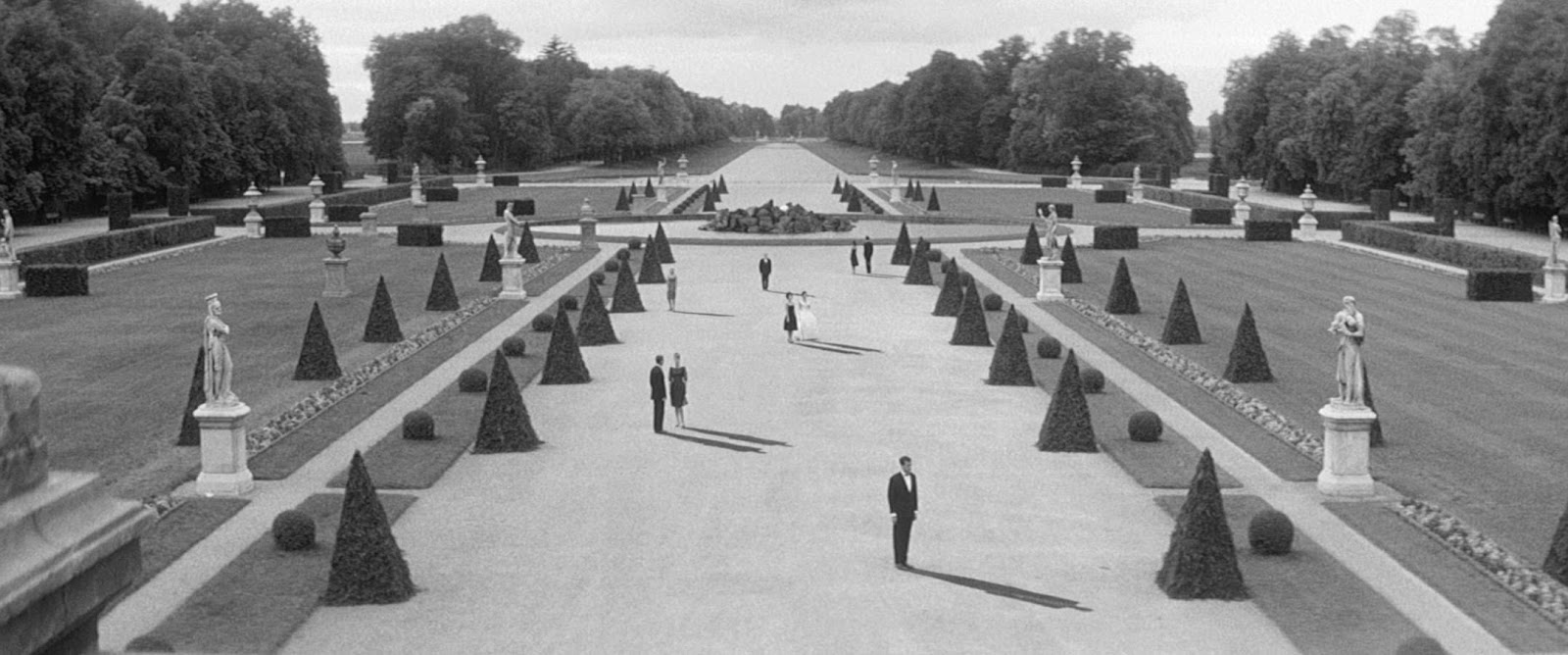
Be that as it may, we are faced with a work that allows endless interpretations (and therefore the one that is exposed here is only one of the many possible), in which the plot is broken down as in an immense puzzle of infinite possibilities; a three-dimensional puzzle in which time and space unfold, overlap, repeat or stagnate, without submitting at any time to the logic of conventional narrative. A minimal plot line is the starting point on which the enigmatic universe of the film is structured: X (Giorgio Albertazzi) is in the rooms of a luxurious hotel with Y (Delphine Seyrig), to which he tries to convince that both had met a year earlier in the gardens of Frederiksbad ("or maybe it was in Marienbad"), citing for a new meeting a year later, and Y claims not to remember anything that X assures him happened. The encounters of X and Y follow one another repetitively and non-linearly (changing the scenarios and the costumes of the characters without any apparent logic) in a scenario inhabited by individuals that act as automatons devoid of any emotion, phantasmagorical shadows that repeat one and again the same banal conversations, the same gestures and movements. The film argues the complexity of metaphysics of presence in a game of absences.  (frame 1). In the midst of this authentic army of undead, among whom the disturbing M (Sacha Pitoëff) stands out, X manifests as the only character with initiative, rebelling against the absence of emotions of all the characters, including Y.

Frame 1
"You have not changed, it seems like yesterday we split up. But you seem not to remember, "laments X during his first encounter with Y (frame 2); and in the face of her refusal, she insists on every new occasion: "It was last year. So much have I changed? Or do you pretend not to recognize me? "Memory or its absence (forgetfulness), themes so present in the first films of Resnais (think of Night and Fog, All the Memory of the World or Hiroshima, mon amour), seem to categorically define the different essence of both characters: X, as a conscious being, tries desperately to provoke (or perhaps generate) the memory in Y, which persists in denying the facts that it describes ("It was not me, you get confused with another person"). Like the rest of the inanimate beings that roam around the hotel, and it seems to base their existence precisely on the lack of memories (and hence the automatic actions repeat stubbornly, as if each time it were the first to execute them).
Frame 2
X's struggle, therefore, is to rescue Y from the shadow world in which she is trapped. Like Orpheus in search of Eurydice in Hades, X goes again and again to the realm of "silent rooms where the noise of footsteps is absorbed by carpets so thick, so thick, that one does not hear one's own steps" in search of his beloved, to whom he gives as proof of his first encounter a photograph "taken one afternoon in the park" (frame 3). But Y negates the evidence and persists in not remembering, or perhaps simply is unable to do so, given its condition of being inanimate (icy human statue that we always see with the same gesture - the left hand on the right shoulder - at first of each new appearance - frame 4).

 Frame 3

Frame 4

"You did not expect anything. It was as if you were dead. But it's not like that. You are still alive. You are here. I see you, "X insists obstinately to break the spell that holds Y among" immobile and silent people, perhaps dead some time ago." And, after numerous and repeated attempts (as evidenced by the image of  opening a drawer in which he keeps countless copies of the same photograph that again and again gave him X - frame 5), finally the hex is broken and X finally gets move away with Y, taking a path "along straight paths, between the immutable statues, losing forever, in the quiet night. Alone with me "(frame 6).

 Frame 5

Frame 6

The movie starts with a fascinating aand disconcerting, labyrinthine and disproportionate at times and no less tricky. "Hallways, carpets, stuccos, mirrors and more corridors, carpets ...", narrates constantly the voice in off, true protagonist of the film. Enjoy architecture, light and gloom as characters; that garden of triangular hedges without shadows in front of the disproportions of the characters, object characters like sculptures inside a board, or the amazing shine of the looks and the lips, the delicacy of the gestures and the rigidity of the bodies and walls.If you penetrate, do it by rushing even in restlessness, letting yourself be hurt and shuddered by that recurrent organ music, which seems to come out of the fingers of a drunken Bach in a night of composition in leaks. Make it all yours, as if, bored in the subway, play to invent the history of the bodies and minds that surround them, mixing sounds and words, looks and conversations, taking them to the field they want. And, if not, do it, you might learn to like so much incoherence, but in any case, do not forget, if you see it, that perhaps without it there wouldn’t be films like The Exterminating Angel or The Shining, much of Scorsese's narrative , the world of Lynch and many others.

The eternal fascination with Last Year at Marienbad  is that every time the viewer thinks he has found the key to the riddle, a new aspect appears that ruins all his theories. For example, when the woman asks the man to leave her alone, he leans against a balustrade that collapses because of the pressure. It must be a fleeting fantasy, the viewer thinks, and when the balustrade is seen again, it will be intact. But it's still broken! Does this reflect the character's unwavering conviction that his fantasy has actually occurred? Is it not more likely that it is a metaphor for a woman's desire to be free of the stranger? Thinking carefully, the second explanation seems more plausible. But, with regard to this enigmatic film, the only thing that can be said is "I think", and never "I'm sure".

In a second reflection, last year at Marienbad, with its subtle clues, its complicated interrelation between past and present and its representation of a reality that can simply be a dream, it acquires the appearance of a detective story. The figures (they are more figures than characters) move in an exquisitely controlled manner by a director who shows the precision of a skilled chess player. The oneiric world in which the story takes place has the quality of a fairy tale and, like most of them, a certain touch of hidden threat that lurks at all times to its characters. The fascination that this film exerts is based on its form and structure, which makes it a key work for 20th century cinema.

Cast:
Delphine Seyrig  A
Giorgio Albertazzi X
Sacha Pitoëff  M

Credits:
Director: Alain Resnais
Screenplay: Alain Robbe-Grillet
Producer: Pierre Courau
Producer: Raymond Froment
Music: Francis Seyrig
Cinematography: Sacha Vierny
Editing: Jasmine Chasney
Editing: Henri Colpi
Production design: Jacques Saulnier
Costumes: Coco Chanel
Costumes: Bernard Evein
Set decoration: Jean-Jacques Fabre
Set decoration: Georges Glon
Set decoration: André Piltant


Sunday, February 10, 2019

La Dolce Vita 1960


This classic of cinema is an exhibition of the “beau monde” of spectacle, scandal, aristocracy and wealth. From the perspective of the journalist Marcello Rubini (Marcello Mastroianni), Fellini shows different episodes where the luxury of a privileged life leads to banal love relationships, ephemeral carnal pleasures and hypocritical friendships. The sweet life has some of the most significant scenes of the filmmaker's work. And it was the film from which the term paparazzi was taken to designate social photographers obsessed with portraying the superficiality of public life. A milestone in the film career of Fellini that greatly influenced filmmakers such as David Lynch or Paul Thomas Anderson.

Life has three great turbulent forces, which manifest as an attractive whirlpool that traps humans in chaotic spirals, something discredited by modernity in traditional Christian symbols these are; the devil, the world and the flesh, the three enemies of man: the malice of licentious reasoning; the attraction of riches and materiality and the sweet enchantment of overflowing sexual energies. When you live under the attraction of these forces you can enjoy the dolce vita, a space without compromises, in which the severe admonitions of normality are not applied, since you live according to the moment, with full disposition to take advantage of opportunities, without sticking too much in the consequences.

We all have those dolce vita instincts, although restrained by social norms and fears of acting in public, of making a fool of ourselves. Federico Fellini has shown in his famous film La dolce vita what is experienced during a series of frantic days and nights, in which everything that happens to a person who lets himself be dragged by the swirls of life. It is a story that focuses on three aspects: what an attractive man, a womanizer, who experiences life with no signs of maturity; what happens in a city like Rome, in a time when everything is changing, and what happens in the feminine worlds, reflected in the stories of the women who cross in the life of this singular man.

The great Marcelo Mastroianni is the protagonist, incarnating Marcelo, a journalist who knows everyone, who is covering everything that happens, who is envied by his colleagues and adored by his photographers and collaborators for his self-confidence and skill. His attractive face, his smile, his gestures, his witty phrases, fill the film and serve as the driving axis, so that the viewer identifies himself, becomes interested in this man so fortunate and so disturbed, that he has time for everything, less to sleep and to behave normally. In an impetuous week he relates to five or six beautiful women; he sentimentally approaches his father, whom he knew little or nothing about; he experiences for a moment mysticism when listening to a work of Bach interpreted by his admired mentor and friend; it is related to the superficial world of spectacle and fashion; participates in orgiastic parties of the upper class; presence death; He experiences machismo and approaches loneliness and tenderness. It gives the impression, and this can be the essence of the dolce vita, that nothing affects you, that nothing learns, that simply exists, lives and experiences, without really realizing it.

Rome is the protagonist city. At the beginning of the film, a figure of Christ is transported by helicopter through the air of the city, with outstretched hands, crossing symbolic places (the ruins of the Baths of Caracalla, the new neighborhoods, the ancient city and the Vatican). He is a Christ made of concrete, without real power, who moves according to the whims and the modern means of man; that does not settle in the hearts, hardly fits in the superficial news of a sensationalist journalist. The Virgin, the traditional Madonna of this Catholic city, is the false appearance of children trained to deceive the unwary, an object of show business, which is filmed as a mass spectacle. In the Roma de la dolce vita one lives in night parties, in the streets at fast paces, in gossip or in cabarets. It is not the life of family homes, nor that of commerce or work; neither of academia or of science. The apparently saner character of this crazy city and of this film, the intellectual Steiner, who looks relaxed, musical and familiar, unexpectedly chooses the madness of suicide and violence against his children. Perhaps if he had aligned himself with the principles of the unbridled dolce vita, he would not have fallen into the depressive networks of which he has everything and knows everything, but without real meaning in it. Marcelo's father, a village man, witty and without apparent complexes, who briefly passes by the Rome of his son, approaches it with relish and then suddenly walks away, almost with fear, when he realizes that he is not a man capable of living the Roman turbulence.

Fellini has managed to film a masterpiece in good part due to the performance of the women,  the scenes in which they dominate the collages of this plotless film. The figure of Anita Ekberg, with her blond, undulating hair, with her cheerful and expressive body, incredibly light and attractive, like a nocturnal goddess, in the fountain of Trevi, remains in the retina of the spectators forever. But the scenes in which this actress answers the disordered questions of journalists with cheerful sensuality and intelligence, or in which she does a picaresque dance with her black outfit, her sensual smile and her blond hair are no less spectacular. In the film, she plays the role of dreamy woman, unattainable for the protagonist, showing that in the dolce vita real satisfaction is not achieved, although it can be slightly touched. Another singular woman is Paola (Valeria Ciangottini), a young waitress from Perugia, who symbolizes the idealized and angelic woman, equally unattainable for a man of the world, by touching her, he corrupts her and makes her lose her innocence. The protagonist moves between two women: his girlfriend Emma (Yvonne Furneaux), jealous, suicidal, resigned to suffer the machismo of his beautiful and unfaithful boyfriend and his occasional lover Maddalena (Anouk Aimée), a rich heiress, so superficial as intelligent. These two women symbolize the forces of stability and turbulence that strike the protagonist, unable to focus and commit.

La dolce vita is a story without plot, admirably narrated. It is worth seeing it carefully, several times, in order to appreciate the expressive art in all its magnitude. Precisely because it is a succession of loose events, only connected by the life of the protagonist, it has been possible for the performance to be sweet, unrestrained, loose, full of other subtle protagonisms. Fellini really managed to make his cast feel drawn by the whirlwinds of his crazy story.


Credits:
Directed by Federico Fellini
Produced by Giuseppe Amato and Angelo Rizzoli
Screenplay by Federico Fellini, Ennio Flaiano, Tullio Pinelli, Brunello Rondi. Uncredited: Pier Paolo Pasolini
Story by Federico Fellini, Ennio Flaiano, Tullio Pinelli
Music by Nino Rota
Cinematography Otello Martelli
Edited by Leo Catozzo
Starring:              
Marcello Mastroianni
Anita Ekberg
Anouk Aimée
Yvonne Furneaux
Magali Noël
Alain Cuny
Nadia Gray


Wednesday, February 6, 2019

Pickpocket 1959


According to French film director Robert Bresson. "A film is not a show. It's, above all, a style." He liked to distinguish between cinema and cinematography. The cinema, for him, was nothing more than filmed theater, while the cinematograph was a new art, a combination of sounds and moving images that, properly harmonized by the montage, was capable of transferring feelings. He did not like professional actors either. “I preferred to work with people who did not have any experience in the world of interpretation and whom I called models.” In short, he sought the very essence of cinematographic language, its maximum purity. That is why his works seem to be surrounded by a kind of aura of spirituality and asceticism.

To understand Bresson, the critic Michel Estève turns to Sartre, who affirmed: "Every technique refers to metaphysics". Notes on the cinematograph is an example of this relationship, from the numerous aphorisms that run around the representation (the "form") and the support (the "matter"), and that hardly make any allusion to the story (the "Content"), and never to faith or religion.

Baes on his aphorisms, Bresson did not even look for the beauty of images-which he calls "cardpostism" -but "the ineffable that you will release". This is the difference between "CINEMA" and "cinematographY". The first is the one that swarms in the exhibition halls and is usually nothing more than "filmed theater". On the contrary, the cinematograph is a search: "CINEMA drinks from a common fund. The cinematographer makes a voyage of discovery on an unknown planet."

Bresson shuns "representation"; that is, to understand the cinematograph as a reproduction of reality. On the contrary, the cinematograph consists of founding a new reality, constituted by the "truth" characteristic of the artistic work: "A thing that can only be expressed by the new cinematographer; consequently, something new."


Many pages would be necessary to explain the Bressonian poetics. However, it can be said that Bresson is entrusted to the machine, from which he praises his "scrupulous indifference". In the machine the cinematographic specificity begins, which continues with the montage. This consists -according to the filmmaker- in stringing images and sounds from the "internal" energy that the paintings contain. A single image is nothing without the existence of others, before or after: the image, devoid of beauty, loses its individuality and is part of a becoming.

Bresson's cinema is consistent with the novelty sought in “notes” on the cinematographer: surprising breaks and links, even opposed to the spatial-temporal logic, unexpectedly and markedly black melted, or sequences that begin or end after or before the action occurs (events that would be so relevant in a film by any other filmmaker, such as a death, attempted rape or murder). Materiality is not only visual: sound is also a fundamental element in the assembly equation. "Noise must be turned into music," says Bresson.

The work of the spectator is an important part of those who have devoted some pages to examine the Bressonian cinematography, like André Bazin and Sontag to the aforementioned Estève and Provoyeur, they all agree that the "writing" of Bresson is not in the images, but in the spirit of the spectator. His films are a constant invitation to reconstruct the story, incomplete or enigmatic that is what’s offered on the screen.

The Bressonian poetics - the exploration of materiality and of the staging, of which Notes on the cinematography gives an account - is finally coherent with that vision of the world: the ascetic image, the actors and actresses of the Stoic mood, the montage "unraveling the narrative." The characters are thrown into a brutal world, in which they must choose between virtue and vice, and accept all kinds of humiliations - as does the ass Random Balthazar, considered by one of its owners as a "saint" - . The immobility, the silence and the strangeness of the characters and situations arouse what Bresson calls the “ineffable.”
It should be noted that the Bressonian stories evolved towards pessimism as the years passed: there is a great distance between the Christian hope of the Diary of a rural priest (the priest dies, but "saves" a soul) and A Man Escaped (the prisoner escapes, against all odds), and the inevitable pain of Au Hazard Balthazar or Lancelot of the Lake.

Pickpocket
It is the story of Michel, a lonely young man who is fascinated by thefts, raised to the level of art. One day he goes to a horse race and steals money from one of the attendees. Confident that no one has seen him, he is surprised when the police stop him. After this episode, a band of pickpockets will teach him the technique of the trade and to exercise the skill of your hands and steal in public areas with many goals.

Filmed with non-professional actors, in the purest Bresson style, and based loosely on the Crime and Punishment of Dostoevsky, this film is considered by many as an essential title in the history of cinema. He was a finalist for the Bear of the Berlin International Festival.

'Pickpocket' is a film of silences, of silent emotions, of hidden feelings. And Bresson hits right on something that a priori is risky: the choice of non-professional actors. It must be said that at certain moments you can see that inexperience, since some do not manage to be as expressive as they should be, and more so in a film of its dramatic intensity. However, Bresson knows very well what is done, and turns all that acting inexperience into one of the best assets of the film, always wanting to reflect the lake of communication of the characters. The apathy of some of them contribute positively to the director reflecting perfectly what he wants to reflect.

During a robbery, something goes wrong. Michel does not realize it, but when he guesses that everything that has happened to him is part of a police strategy to find his apartment, he must flee with the money he has. Michel then decides to earn an honest living, but he has to do it outside his home, to hide from those who persecute him.

"This is not a police-style film, the author tries to express through images and sounds, the nightmare of a young man pushed by his weakness, in an adventure of theft for which he was not made for. Strange ways, will reunite to two souls, that without it, perhaps never they would have known ". With this prologue Robert Bresson introduces us in one of the seventy-two most beautiful minutes that have existed in the seventh art.
Michel is a lonely young man, living in a small room full of books. The relationship with his mother is distant and is in charge of Jeanne, a young woman who has been abandoned in turn by her mother and who lives with an alcoholic father. Michel’s attraction to thefts, is more about fascination and experiencing different sensations, given by his intellectual superiority and personal satisfaction, than by real need. When his mother dies, Michel will dedicate himself professionally to what until now was a pastime that brought him some benefit.

Pickpocket is photographed in a splendid black and white by Léonce-Henry Burel, Bresson, the director draws us, in his fifth feature film and, using a linear voiceover, a sober and lyrical story where objects, hands and looks are much more eloquent and necessary than any high dialogue. Magisterial and millimetric is the assembly of the planes of the theft of purses or the very first planes of the protagonist's hands that hypnotize us for their perfection.

Michael is played by Martin Lasalle, a true stranger, and his first and last role with the director, since Bresson hardly used professional actors in his films, since he had the belief that their inexperience helped them to offer more spontaneity to their characters ; to achieve it he only worked only once with them.
The characters of Bresson's cinema are almost always marginalized beings and offenders of the rigid rules imposed by society. Beings that experience a deep loneliness, anguish and uneasiness with a tendency to isolation, but with a great spiritual wealth, although this and its redemption, through love, come from within the bars of the prison. Bresson does not encourage us to judge or prejudge the criminal behavior or lack of ethics of Michel, although this is contrary to law and outlaws, but it is his own moral: - "The fact that we know something is wrong fact, it does not prevent us from doing it ". A nihilist would not find anything reprehensible this behavior, if it is to feel satisfaction or pleasure in the execution of some act that moves us away from reality.

Bresson, with a brief but shocking filmography, places Pickpocket, in his own right, among the best films in history. We will not find in it action or a fast-paced rhythm, or eloquent dialogues, but mostly in contention, simplicity, silences and subtle glances, portrayed by the French through a fluid narrative and planes and with a montage of extreme beauty and delicacy. And since beauty cannot be described, but is made to be felt and contemplated, it is absolutely necessary to see it.

Director: Robert Bresson.
Cast: Martin LaSalle, Marika Green, Jean Pelegri, Dolly Scal, Pierre Leymarie, Kassagi, Pierre Étaix, César Gattegno.


Tuesday, January 22, 2019

Double Indemnity 1944


A Film Noir Masterpiece. In 1938 Walter Neff, an experienced salesman of the company Pacific All Risk Insurance, meets Phyllis Dietrichson, the seductive wife of one of his clients, with whom he begins a romance. Phyllis proposes to murder her husband to collect the life insurance policy and Walter devises a plan to receive double the amount based on a double indemnity clause. When Mr. Dietrichson is found dead in the train tracks, the police take it as an accidental death. However, Barton Keyes, an insurance analyst and Walter's best friend, suspects that Phyllis has murdered her husband with the help of another man.
As long as there are women on earth there will be men who will go crazy for them, this is precisely what makes this masterful film by Billy Wilder, one of his best works and without a doubt the first masterpiece of his filmography; timeless, immortal.

After the credit titles superimposed on a plane in which the silhouette of a man walks supported on crutches accompanied the music of Miklós Rózsa, a car recklessly runs at high speed. Finally the car stops in front of an office building and a man walking with difficulty comes down. Once inside the building and after a trivial conversation with the elevator operator, our man enters an office, turns on a lamp  and lights a cigarette in this order, approaches a dictaphone and begins to dictate what is soon revealed as a confession of murder. The man in question is Walter Neff (Fred MacMurray), an insurance agent who confesses to his boss Barton Keyes (Edward G. Robinson) that he is the author of the murder of Mr. Dietrichson, a client of the agency whose recent death was supposed to be a real problem in the sense of having to pay a hundred thousand dollars as a result of the conditions of the policy, Neff clarifies "I killed him for money and for a woman, and neither I nor the woman got the money ".

We are in Los Angeles on July 16, 1938 and in the sixth minute of the film; Billy Wilder has just made the wildest spoiler in the history of cinema. He has a hundred minutes ahead, but he just told us the end, not only has he let us know who the killer is but also what his motivations were and the ill-fated end of them.
How is it possible that during the next hundred minutes, Wilder not only manages to give birth to an authentic masterpiece of cinema, but also maintains a constant intrigue and tension level despite having revealed the end?

It is all about the wonderful script. A script full of wonderful dialogues, and masterfully written by Wilder himself and the great screenwriter Raymond Chandler who adapted a novel by James M. Cain entitled "Three of a kind". However cinema is not just about the script, but in this case Wilder’s directing expertise, which is evident throughout the entire film. The presentation of the female character, Phillys Dietrichson (Barbara Stanwyck) at the top of a staircase, implicitly naked and only covered with a towel is loaded with more eroticism than all the footage of other films allegedly transgressive.

After the beginning of the confession, a first flashback transports us to two months before while Walter Neff's voice-over continues to introduce us into the story. This voice over that will appear several times throughout the film is used wisely by Wilder who uses it to streamline the story through tuned ellipses and introduce some characters without overloading the footage.

Wilder handles the narrative with a master hand, managing to maintain the tension in three aspects, on the one hand the sexual tension between MacMurray and Stanwyck, secondly the tension of the plot with several accessory plots (that were revealed as fundamental in the outcome) as the courtship from Phyllis's step-daughter, Lola (Jean Heather) with some guy with an Italian name, and thirdly, the moral tension that provokes in the spectator the stance of a hero-villain, a murderer whose downfall we can only feel pity.

Fred MacMurray, undoubtedly before the role of his life, offers the best interpretation of his career. Barbara Stanwyck is dazzling and her interpretation laid the foundations of what would later be the prototype of the “femme fatale” in film noir, her creation of Phyllis, full of sensuality and perfidy in equal parts, gave her the third of her four Oscar nominations, although like on the other three occasions, she did not receive the Oscar and the award went that year to Ingrid Bergman for “Gaslight”.

Edward G. Robinson completes the protagonist triangle with an unforgettable character on which the film is articulated by addressing to him the initial Walter Neff’s confession and being the reference on which the script returns whenever it needs to rely on a character that gives meaning to the plot. His sixth sense to detect fraud comes to life in that unforgettable inner voice that compresses his stomach and does not let him eat every time he smells trouble.

 Double Indemnity (double compensation) refers to a clause that Walter introduces in the insurance for which the insured amount becomes double if the accident occurs in train. The double compensation refers to an element of the plot, but is the downfall of the story itself.

Double Indemnity got 7 Oscar nominations in 1944 but did not win any awards, the nominations included the categories of best film, best director, best actress for Barbara Stanwyck, best adapted script, best picture, best sound and another for the wonderful soundtrack by Miklós Rózsa.

Cast:
Fred MacMurray as Walter Neff
Barbara Stanwyck as Phyllis Dietrichson
Edward G. Robinson as Barton Keyes
Porter Hall as Mr. Jackson
Jean Heather as Lola Dietrichson
Tom Powers as Mr. Dietrichson
Byron Barr as Nino Zachetti

Richard Gaines as Mr. Norton